Showing posts with label Dungeons and Dragons. Show all posts

Thursday, September 18, 2014

D & D, the 1d4 edition

By David


Dungeons and Dragons turned 40 this year and a new edition was released. It is being called simply: D&D or Dungeons & Dragons. No number added, no advanced moniker. A starter box is being sold to provide a start up point for new players (it covers just some introductory rules with pre-made characters so a group of players can jump in and try it out before committing to something more. The Basic Rules is available as a free PDF download here. Anyone can take a look, read it and even play it before deciding whether to invest in the printed books (which contain more character options and other extras.) All of this is very encouraging in tone and intention, and I have read many articles and blogs by all sorts of gamers giving the new edition a read and/or try. I have also read many who give it a qualified thumbs-up. Comments range from this being their new system of choice to: its okay, but they are going back to “You can insert other system or edition here.”


Like many, I followed the public playtest--an unprecedented event (at least, it was to D&D’s parent company) and I was impressed. The rules were intriguing, the idea of having a voice in the development was appealing and it seemed they were trying to follow through with the promise of drawing from D&D’s rules history and player feedback to create a game for nearly everyone, even promising rules modularity (player groups can add to, or take away pieces of the rules set to suit individual play styles.) This design, if carried out, would be a formalization of something from the beginning of the game. The oldest editions can be pulled apart, sections altered or rewritten, and played without the entire game collapsing. The original rules were not elegant, but they were very customizable.


So, in theory, one could play the new version of D&D as if it were:


Edition 1 (Advanced, or AD&D) Formalized and comprehensive rules (even though every rule was handled with a different mechanic), intended to provide consistency of play even if you played with different groups. Characters were very individualized, everyone did something special or unique.


Edition 2 (Second) A few tweaks to the AD&D rules, including more survivability (the beginning of adding “plot armor” to the player characters, so no one would feel they “lost” the game.) And more character options (a booklet for every class and race!)


Edition 3 (3.5) Lots and LOTS of crunchy rules (a rule for everything; no arguments, unless it was over rule-interpretation.) Although, most were handled with the same simple die roll: easy to remember which dice to use.  Also, more character options (create nearly ANYTHING you can imagine.)


Edition 4 (4E) Boardgame-like rules. Epic characters (players are unquestioningly the HEROES, complete with full “plot armor” and a menu of options and cool maneuvers (with names, like “Falling Star Strike” and “Rub Some Dirt On It”!)


I like this notion of being able to play your way as a concept; I love tinkering with game rules to run things the way I--and those I play with--enjoy most. I also like several aspects of the new rules set:


Advantage/Disadvantage a simple mechanic for modifying any die roll: most challenges are decided by rolling a single die; if you have advantage, you roll 2 dice and pick the best, disadvantage means you roll 2 dice and pick the worst. In other editions there were, literally, pages and pages of +1, +2, -3, etc., modifying various die rolls for various conditions. The advantage mechanic is a convenient “on the fly” rule simplifying things during play.


Optional special abilities As characters progress, they gain new benefits and features; this can be handled as simply or as complex as a group wants. This is evidence of the modularity they spoke of in the beginning. I like this as a limiting factor in the menu options at the table; I want players to be able to do whatever they imagine, not feel limited to just what is written on their character.


Ease of creation for the referee 4E did this really well and it seems to have carried over to the new edition. There is a lot that goes into a session: trying to give each player a chance to shine, providing challenges, making it all fun (for both the players and the referee) It shouldn’t feel like work to prepare for a night of D&D; this new set seems to understand that for the most part.


What I don’t like is the execution in some areas of the new rules (admittedly, these rules could be removed or altered):


Superhero aspects of the system.


Healing. I understand it is no fun to lose a character; especially when you put a lot of time and creativity into it. And I am not suggesting that characters should be easy to kill. But there is something a little too super about the way characters can recover from near death wounds in this edition. Jeopardy is what makes us care about a character; immortality becomes tiresome.
Magic. Even basic spells are phenomenal. Apprentice wizards are a little more like Nicholas Cage and a little less like Mickey Mouse.


Character advancement and improvement.


Characters begin with too many special abilities--in my opinion. It is far more satisfying to begin simply and gain in power than to begin powerful. Of course, it is a matter of taste. Would you rather be the commoner who aspires to kill the dragon? or the dragonslayer who seeks to slay another?


Monster presentation


The stat block for monsters has too much mechanical detail (it looks very much like 3.5, which pushed me away from that edition and keeps me away from Pathfinder) I don’t want to memorize--or even refer to--a single monster with its own character sheet, especially when I may need to juggle five or more different monsters in a single session.


As an overall complaint, I don’t see the promised modularity of the system yet. Currently it is as customizable as any edition has been, so it may be a non-complaint so far. And the modularity may be something yet to come, but if this is the base from which to decide what to add from here on out, I am not satisfied that it is basic enough (since I would want to remove parts to run it my way.)


Finally, despite the niftyness of the Starter Set ($20) and the convenience of the basic rules with promised updates (all free), I am very discouraged by the price point of the printed books (Player’s Handbook, $50; Monster Manual, $50; Dungeon Master’s Guide, $50; $30 each on Amazon.) Even considering inflation since I purchased my old edition AD&D books (1980’s, $20 each), that is too much money to invest in a rules set I will not use in its entirety.

I think I will sit this edition out and instead stick with the nostalgia of my classic (Moldvay) version.

Wednesday, August 13, 2014

What Kind of World Do You Want? Part 2

 What Kind of World Do You Want? Part 2
By David


A little basic sociology


In the first part of this post I talked about the hooks, or points of relevance, distinguishing my created fantasy world--Archaborea--from other fantasy environments. I also mentioned how the method to my creation came from a series of articles called “Dungeoncraft,” by Ray Winninger. He had a short list of rules for creating successful worlds which I also choose to use in my process.


Rule #1: Never create more than you must.


Rule #2: Whenever you create something important, create at least one secret tied to it.


Setting the stage for my creation’s adventurers (the players,) I look at the second entry on my list of hooks: The Bad Guys Rule. The evil empire is alive and well on Archaborea. However, due to the nature of the environment (remember that grinning cactus?) even the tyrants have their limitations. So there will be a tyrannical, despotic government but it will be balanced out by the savagery of the natural flora and fauna. I am thinking I may give my heroes a choice to start in a small village under the rule of an ogre-lord “regional governor” or a small village in the wilderness (sort of a pioneer village surrounded by packs of predators and other natural hazards.) They will have a small, manageable homebase, but also some kind of instant challenge, either natural or political.


Along the way, I am aware of potential plotlines and adventure ideas. That is what this process really does, it helps to set things in place and spark ideas, stimulating my creativity. My hope is that my players will feed off of this creative energy as well and together we can build a compelling story within the game, resulting in fun for everyone.


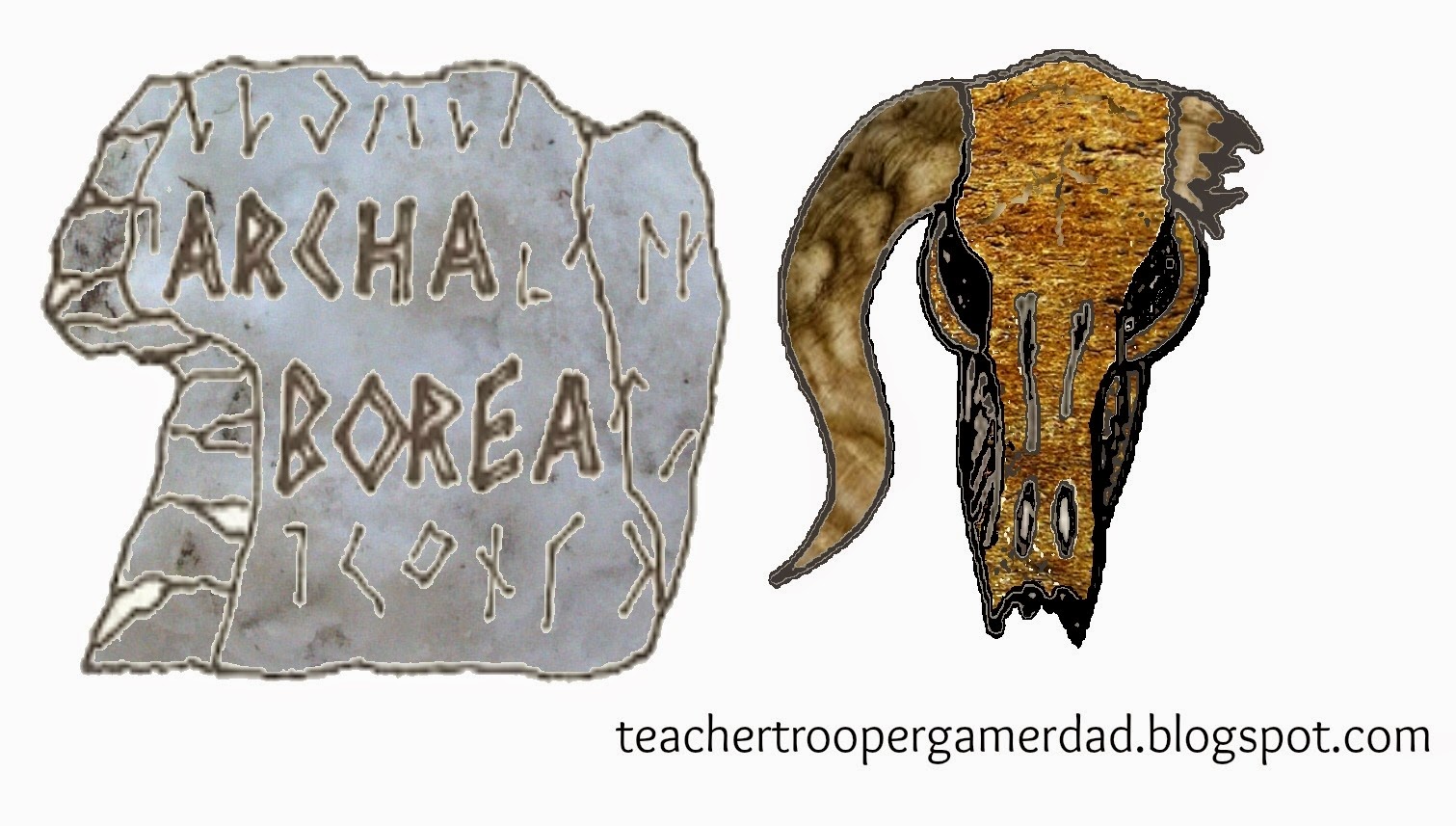
Using rule #2, I have established that the evil rulers of the world (although called “ogre-lords”) are not actually ogrish. They will be beastly in appearance, looking more like minotaurs, with bovine heads and horns, and bulky, hirsute bodies--not fur-covered, just hairy. The secret of their heritage will be something I want the players to discover over the course of the campaign and may include other, unknown villains they will not expect.


My hook established the ogre-lords as conquerors in a war long ended. The length of time I am not sure of yet; somewhere between fifty and one hundred fifty years sounds about right. Enough time for society to have settled a bit, established some norms and traditions in the wake of war, but not so much time that no one remembers the conflict, perhaps lost a parent or grandparent. This being a fantasy realm, its also possible for some long-lived race to have members who actually fought in the war. The war will be a quasi-taboo topic: some want to forget and move on, some want to start it again, hoping for a better outcome.


The village homebase for my players will be a combination of races living and working together. This will allow for the players to be able to choose any race they wish. I don’t want to limit my player’s choices of a character too much because I will be limiting other things as a result of the environment. It is really all about balance, trying to balance what can and cannot be. The village itself will be small, not more than a few hundred at most, with roughly ten to twenty percent of that number belonging to the village militia or guard. When it is decided whether the village will be a pioneer village or an ogre-lord village then that will inform the disposition of the guard.


The village will also be relatively isolated because the nature of the world limits population centers. Nature plays a big role in this world; it will be as much of a challenge as some of the humanoid foes the players will face. A later post will cover this environmental aspect, but for now I will concern myself with some names and personalities the player characters may encounter: the leader of the village, the captain of the guard, a few townspeople (a tradesman, a shopkeeper or two, and maybe a couple farmers.) I will outline the village: a list of major buildings (in alphabetical order for ease of reference.)

Maps will come later, but next part of this series will be religion: god(s) and myths.

Monday, March 17, 2014

Tabletop Gaming is Alive and Well

Thanks to The Save or Die Podcast for reading my email and passing along my shameless piug for this blog.


Hear the podcast at this link
http://saveordie.info/?p=1034


I mentioned back in September that I was listening to this podcast and how much it reminded me why I love my hobby. It also spurred me to become more active in creation. I have started working on a campaign world to set adventures in. My children and I have begun to play again (using a house-ruled version of the Moldvay set, despite my intent to return to my Holmes roots.) And I am working on some other ideas with an intent to publish.

The gaming hobby is so much more available now than it seemed back in the 80's. Finding a gaming store used to be a 90 minute bus ride to a hole in the wall, or a single shelf at a tiny bookstore. Now the local gaming stores have more open gaming demos, so you can try out a game before you invest in it. And finding the game you want can be as easy as typing the name into your browser. The hobby feels more alive and less secretive now.

What is your gaming experience? Do you want to start some? Give it a try; role-playing is not dress-up, and its not funny voices surrounded by dim, dark walls and flickering candles, as some of the lurid movie-versions would have many believe (I'm looking at you Tom!)

Tuesday, December 17, 2013

What Kind of World Do You Want?

By David

Once upon a time, when Dragon Magazine was still a print entity found in magazine racks, a feature series captured my attention called Dungeoncraft, penned by Ray Winninger, the series gave step by step advice to dungeon masters for creating memorable environments for their Dungeons and Dragons games. The article entries were fun to read even if you never used them in a practical sense and they occupied my bookcase--never gathering dust--for many years. I've been reading them recently to give myself a focus, or at least a starting point, in the creation of Archaborea, my new fantasy world.

The first step is to decide on a hook, the points which would define and characterize my world. I had many ideas to begin with: themes and concepts I wanted to explore and exploit, but what were the headlines? What made my world unique?

Archaborea; the essentials.

Primitive Savagery and High Adventure.
I wanted something non-standard: less Tolkien and more Burroughs (although, G.R.R Martin "politics" aren't out of the mix.)
Most of the world is undeveloped or even unspoiled by mortal hands. In the heavens, elemental powers wage an eternal war with elder beings; think Mother Nature versus Cthulhu. The collision of natural and unnatural forces result in jagged mountains, breathless jungles, sucking swamps and infernal deserts. Fell beasts and even predatory plant life abound outside civilized areas. Those who rise above daily survival to seek their fortune are truly exceptional, the stuff of myths and legends.


The Bad Guys Rule.
This one has become a standard, but it provides a good backdrop for other ideas. Also, the Evil Empire trope is near and dear to me...
A decades-old war established the domination of the Ogre Lords (somewhat of a misnomer which stuck; no one knows if the lords are actually of ogreish descent...) Conquerors rumored to have their own fearful rulers, the Ogre Lords have erected fortresses of stone to protect their slaves and subjects from the wilderness and each other. Cities and villages are few and far between existing in places where people have put down roots, determined to hold their freedom and their ground.


Metal is a rare commodity.
This played into the primitive savagery angle, and gives an extra challenge to the potential heroes. The will need to be creative and resourceful in order to arm themselves.
The Ogre Lords and their warlords, enforcers/sympathizers, attempt to control potential uprisings by controlling superior weaponry, keeping the best for their personal armies. Metal weapons and armor are seized at fortress gates and most metal mines are controlled by the Ogre Lords. Metalworking skill has been forbidden to the general populace, punishable by death. Common arms and armor are more often made of leather, wood, bone, stone, and other such materials. Because iron and steel are hard to come by legally, many have become very creative in their materials and designs for personal protection.


Religion is not about faith.
In a world where the very forces of nature are at war, fate and destiny can seem very fickle.
Faith and belief in Archaborea relies on what can be seen or felt. The majority worship primal forces and the natural elements-even if the primal spirits are often wild and vengeful. Elder beings grant power in return for subservience and sacrifice.


Arcane magic is feared, Elemental magic is revered.
I wanted to enforce the notion that magic is mysterious and powerful; I don't like magic being commonplace or expected. Again, back to pulp stories like Robert E. Howard.
Sorcerers and Magicians are viewed with awe and fear by the superstitious populace. True magic power comes from forces often grotesque or beyond comprehension. Shamans and Priests harness the power of nature or elemental forces. Devoted worship can grant the ability to create what some view as miracles.


Adaptation for survival means the term “race” is often only about physical appearance.
I don't like racial stereotypes as a rule. And I had some ideas for mixing up the traditional stereotypes of fantasy races. Why did dwarves need to be stoneworkers? What if dwarves could be "cowboys" or mountaineers?
The wars of conquest by the Ogre Lords displaced many from their traditional areas and the races of Archaborea have adapted to “non-standard” geographical locales. The race referred to as “Dwarves” are not all subterranean miners, some may be plains nomads surviving by herding, trading, or raiding; low and stout in appearance, but wayward and surprisingly quick. “Elves,” lithe and sharp in their features, are as likely to be found on a mountaintop, or lurking in the catacombs below cities, tradespeople who keep the city structures intact. Outside of the fortress walls, tribal structures are much more loose and varied racially; the masters of the Jade Forest might be composed of gnomes, fairie folk, and humans, living side by side as one.

Mr. Winninger had two basic rules he used for this process.
1. "Never create more than you must."
2. "Whenever you design a major piece of the campaign world, always devise at least one secret related to that piece." I have hinted at some potential secrets in my hooks, but I will not reveal them yet. Next comes a little basic geography and sociology to give my heroes a starting point.

 What Kind of World Do You Want? Part 1

In my head, the "ogre lords" look more akin to minotaurs, hence the note in The Bad Guys Rule hook...

What Kind of World Do You Want? Part 2

Friday, August 23, 2013

Did I mention I was (am) a nerd? Did I need to?

I grew up watching a healthy (read: insane) amount of tv and movies. At age 6, I can remember running, screaming out of the theater during The Towering Inferno. (As a parent myself, I would not take my kindergartner to a movie like that, but I am not putting down my parents. Those were different times and I turned out well, in general.) My parents made up for it three years later when they took me to the drive-in to see Star Wars. I don’t hate the prequels, but the original trilogy has a special place in my heart.
Sunday mornings as a toddler I spent looking at the comics while my Papaw sipped his coffee and Nana pored over the editorials. (These were the same Grandparents responsible for giving me my first Dungeons and Dragons set--the blue, Holmes edition--best grandparents ever!)
Beyond the sunday funnies, I read anything and everything I could get my hands on. By the time I reached High school I had already read the novels being required by the English teachers. Teachers loved me, students hated me; the life of a nerd in the 80’s. Did I mention I was (am) a nerd? Did I need to? Enough about me.
See you again next week!