Showing posts with label development. Show all posts

Thursday, November 6, 2014

When I Feel...

“You can feel however you want to feel, as long as you don’t hurt anyone, even yourself.”


My wife and I always said this to our children, because sometimes--in our respective extended families--emotions were suppressed. People were not allowed to feel or to express what they felt for fear of upsetting things or offending people. There is a fine line between being aware of how your thoughts and words will affect those around you, and not being concerned with what others think of you. Expression is important, and so is fair treatment of others.


As human beings, we are going to have some very extreme thoughts, things we would never in a million years want others to know about, actions that we would never actually go through with (how many times have you said you wanted to kill that driver ahead of you in traffic and how many times have you actually done it?)


Allowing ourselves to feel the way we feel is important. If you are constantly pushing your feelings down without at least reflecting on them briefly, you are doing yourself a disservice. Suppression and repression are what lead to anger management issues, self-loathing and sudden violent temper tantrums. We need to remind ourselves that it is okay to be angry, sad, disappointed just as much as it is important to feel happy, excited and joyful.

We have these emotions for a reason, and we are still reasoning beings. Just because we picture in our heads the obnoxious politician being run over by his own bus, we know that would not solve anything. The sudden movie in our heads is just a passing flash; life goes on and we can write an angry letter, peel some potatoes with a very sharp knife or just snap our fingers at it and dismiss the inconvenience from our consciousness (okay, I wish it were that easy.)


The point here--getting back to it--is to give our children (and ourselves) the tools to handle life’s challenges. And part of that is the emotions we feel. When I was in school, we had an assignment to write our own children’s book. We could do whatever topic we wished, whatever format we liked but it had to conform to children’s literary standards.

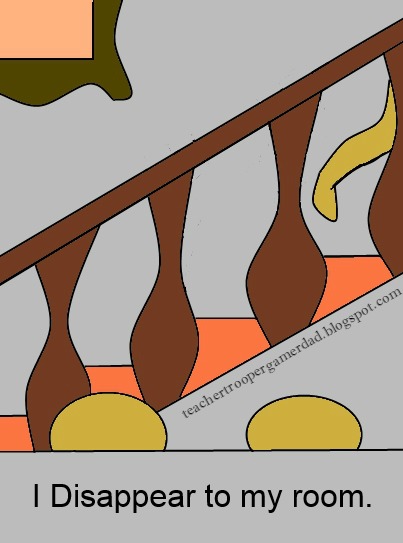
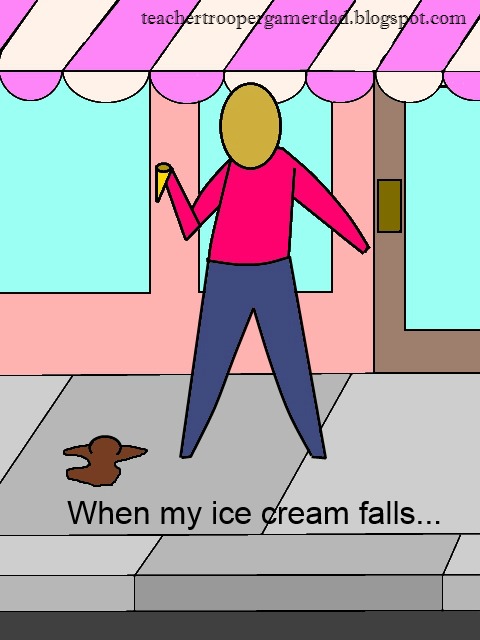
I created a book out of construction paper using circles, triangles, squares and other shapes to convey simple scenes with one line of text at the bottom of each page. It was similar to a poem in structure with each back to back set of pages showing a before and after. For example, the first page would go something like:



MomDadGetLoud Branded.jpg


Turning the page over would then show this:


MomDadGetLoudB Branded.jpg


The idea was to show a situation and the response from a child’s perspective. My thinking was to provide a talking point for parents and their children to discuss potentially difficult topics. But in class, some suggested that it gave the children permission to feel unsure about things, that not everything had to have a conclusion and that was okay.


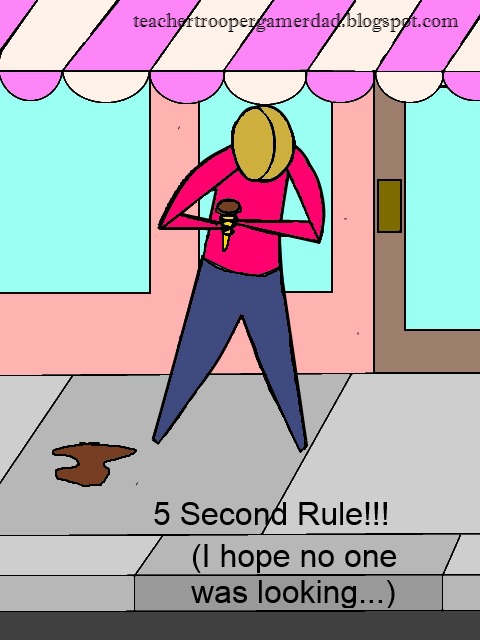
I began to think about this again recently. Here is a more light-hearted sample:


5secondruleA Branded.jpg


Wait for it…


5secondruleB Branded.jpg


What do you think?


What do you do when faced with things that are frustrating or disappointing or downright infuriating?

Tell me how you feel in the comments.

Wednesday, July 30, 2014

The Consequences of Parenting

By David

Becoming a parent is easy; the follow-through of BEING a parent is the hard part. I have an acquaintance (lets call him Ward.) Ward has five children, aged elementary up to high school. I have four, from elementary up to college. Now, I don’t consider myself a better parent because I have been at it longer, but..(you knew that was coming, didn’t you?) I like to think I’m more successful at it because I follow through.


Children learn through practice; it’s like the scientific method:


1. Observe
2. Make a guess
3. Try it out
4. See what happens
5. Return to 2., using those results, repeat.


Consistency is a key factor. If the results are always different, they get stuck in a loop leading to either boredom or frustration. When you say something, children will trust you, until they see different results for themselves. This may be by simple observation or by testing the limits. (For my own children, testing the limits occurred during the even years; the terrible 2’s, 4’s, 6’s,...18’s, 20’s, you get the idea)


So, when I tell my children, “don’t go out of this yard or you’re coming in the house!” They expect to come in if they step out of the boundaries. If I do not follow through with the condition, they may not believe me next time, my credibility and authority will sink.


By example, Ward was packing up his minivan, getting ready for a camping trip; his children nowhere to be seen, except the youngest (8) who is on the side of the house hitting a piece of wood with an aluminum bat.


“Knock it off!” Yells Ward..
“Okay.” the boy stops, watches his father return to the van, and resumes his testing of what the wood does when he smacks it with the bat.
Ward pokes his head out of the van again. “I said knock it off! Go inside and get your blanket. I want to get packed so we can get out of here!”
The boy doesn’t respond verbally, but waits for his dad to resume packing, then he resumes hitting the piece of wood.
Ward steps out of the van and approaches the boy, who stops, lowers the bat, and looks a little sheepish.
“That’s it,” Ward yells. “You are not going camping with us. You’re staying home!” He takes the bat and hurls it aside, returning to the van. The boy just looks on, appearing to consider his next course of diversion.


Now, Ward had already told me they were all going to be gone and the boy was obviously too young to stay by himself. It is an empty threat that he has no intention of carrying out. And this is not the first; Ward doesn’t follow through even when he makes a reasonable threat. He simply sighs and walks away. It’s too much effort for him to spend the time carrying out the punishment. He wants to move on to something else more enjoyable. The boy knows it, I know it, and the rest of his kids know it.That is why they don’t really listen to him unless there is something in it for them.


Where is June (his wife) while all of this is going on? Usually, whenever real parenting needs to happen she disappears, and when the coast is clear she reappears. Ward and June practice what my wife calls uninvolved parenting.


Every parent has probably overheard (or even said) things that would never happen in an effort to urge kids to follow directives. But that is where the consistency matters. If you always use ridiculous threats and promises, the children will see no benefit to following authority. The first time they see something actually happen, with consequences, it will probably make them step back, dumbfounded or possibly angry.


As parents, we have a responsibility to ready our children for the outside world. They need to be able to determine potential consequences of their actions and whether someone is bluffing or being genuine. It’s a matter of simple survival. An empty threat now and then is okay because it provides a contrast to the real ones. Helping to build the child’s judgement by giving them comparisons. That punishment is ludicrous, the child thinks, there is no way they can back that up, why would they say that? Now they have to think, consider what you might really have meant, read between your words.


By the same token, parents need to be prepared to back up what they say when necessary. Then, when it happens, the child will think about it next time: That promise sounds like it could actually happen; do I really want to risk it?


This way, they learn to think on their feet. When they are on their own, they will have to predict the consequences for themselves and weigh the risks. If all your threats are without meaning, what will they expect? That nothing will (or should) happen? What about when another person, or adult, says something (and follows through)? Will the child feel betrayed? Will they think it unfair, even if it was perfectly reasonable?

We have to learn consequences if we are to survive and cope with the world. Follow-through as a parent is a big part of teaching that. What do you think?

Thursday, February 27, 2014

No Dodgeball in P.E. Okay. No Square Dancing?

 Students are not allowed to play dodgeball in physical education anymore. I understand that; I don’t agree with it, but I get it. Some will take the notion of throwing a ball at another person too far and people will get hurt, it will turn the class into an opportunity to fulfill someone’s vendetta against another, and the resulting adrenaline rush will take it even higher. Put aside the ridiculous idea of punishing everyone for the misguided actions of some, of making rules so that we don’t need to monitor what’s going on. Put discipline and guidance on autopilot by simply outlawing an activity which might need constant attention and clear expectations.

But square dancing?

Okay, maybe this wasn’t the result of someone swinging their partner into a wall, or dosey-do-ing a little too vigorously, but why? Square dancing is a great opportunity for learning. Focus student energy on moving in time with the caller’s mark.  The combination of two types of engagement (kinetic and audial) serves to greater cement ideas in our brain. Exercising the body and processing verbal instruction is a terrific lesson.

And if student engagement with the music is an issue, the rhythm and cadence of square dancing is not far removed from current musical styles. I think there is even a song on top 40 radio with a chorus that says: “Swing your partner, round and round.”

And there is no winner or loser. This is truly an activity where everyone deserves an award for participation: something I do not always agree with. In competition, the first competitor should be ourselves. But there is nothing wrong with being a winner. as long as you do not call someone else a loser.

You should feel happy because you accomplished something which took effort and determination. You should NOT try to compound that feeling by taunting those who didn’t quite make it.

Not everyone is going to succeed at everything they do, and we shouldn’t expect that: losing is learning. In loss, we have the opportunity to reflect on what went wrong, change it the next time, or do something else entirely. Take chess, for example. We learn more from losing than we do in victory.

And, to end on a cinematic note, one of my favorite movies made a great point about superiority complexes.

We all have different talents and abilities. Not everyone can be super at everything. “Because when everyone is super: no one will be.”

Tuesday, December 24, 2013

Her Glass Slipper was by Converse


Its been a long day and there's still work to do
She's pulling at me saying, "Dad, I need you
There's a ball at the castle and I've been invited
And I need you to practice my dancing, oh please, daddy, please"


This song, Cinderella by Steven Curtis Chapman, punctuated the Princess Ball my daughter and I attended last month. Coincidentally, these lyrics of the song almost perfectly describe the theme of the evening…


The Whatever Girls is an organization begun by a friend of mine and designed to provide intentional guidelines for parents and daughters about making good choices. The world has become so overloaded with options for expression and desire, that the question becomes one of discernment.


I think it is most important to talk to children, even--and especially--about the uncomfortable stuff. If you can talk, without judging, and give them your opinion without dismissing theirs, it can go a long way toward creating a situation where they will make the right choice. Often, they listen, and if they feel their thoughts are important (i.e. you didn't just tell them they were wrong, or bad,) they may make the decision you wanted them to; because you valued them, they will value you.


How do we know what is the right choice, or even the best choice? The Whatever Girls provides a forum for helping guide the decision making process. And helping parents and their children--a companion forum for boys is being discussed--talk about what might be important to both.


I hope you check it out, whether you’re a parent or not (you might be the cool aunt or uncle one day.)


The Princess Ball was a dance designed to allow dads and their daughters to share a night out together. For me and my daughter, it provided for bonding as well as time to share some proper date etiquette (she was rather annoyed with me because I didn't open her door quickly enough. Later, she waited very primly for me to pull out her seat; I hope she doesn't settle for any less when she truly starts to date.)


We talked, we laughed, we took goofy pictures, and even danced (I think my wife was a little jealous.) At the end of the evening, they played the song above and we slow danced, both of us bawling our eyes out. It was incredible, and I don’t think she will forget it.


I know I will never forget it; it was practice for that day when I will have to let her go. I know it won’t ever be easy to let her grow up, but I hope that we’ll never grow apart. And no matter how grown up she gets, I will never grow tired of hearing: “Dad, I need you…”

Wednesday, November 27, 2013

Not in the DM's Guide (Dads/Moms Guide)


A friend of mine, on his 18th birthday, came home to find his mom, a cake and his packed suitcases. His mom said, “Happy Birthday, I’ve done my job, you’re a man, and you’re on your own.” Now, that is paraphrased from my friend’s account of that day, but the facts are accurate. His mother turned him loose on the world when he turned 18. I have known others who have moved out of their own volition when they turned 18, still others who stayed with their parents until mid-20s or later. But my question is this: When is it time to strike out on your own? And does the impetus, whether internal (choice) or external (forced) have anything to do with the growth process?


I have a son who is 22 and a son who is 20, both still living with me. One is working full time, while the other is going to college. My wife and I told both that they could live at home as long as they were being productive (i.e. pursuing higher education, or working full time.) I am worried that I might be hampering the growth process in some way. Now, I know going to school and working to support oneself is a daunting task, but to the son who is working full time, am I doing him a favor in the long run? We have talked about his future plans and he does want to be on his own, but if there are no other issues (attitude, slacker behavior, etc.) is it really bad to want your child staying at home?


Other parents I have spoken to have handled this in different ways. Some have evicted their adult children, some have taken on a tenant/landlord relationship. I know that I moved out of my parents house and survived; my wife (his mother) did as well. It shouldn’t be an issue of fear, so long as I have done my job as a parent, right? He should not end up sleeping on the streets (unless he chooses that, of course.) And that is the rub. Am I hanging on because of fear of losing him? Cutting the apron strings (or the umbilical cord) is not without some pain. All change is painful, but it doesn’t need to be the end. My dad and I never talked much while I was growing up, but he became a friend when I left home. My own son and I have a pretty good relationship now; I wonder, will it strengthen, weaken, or not change much if he moves out?